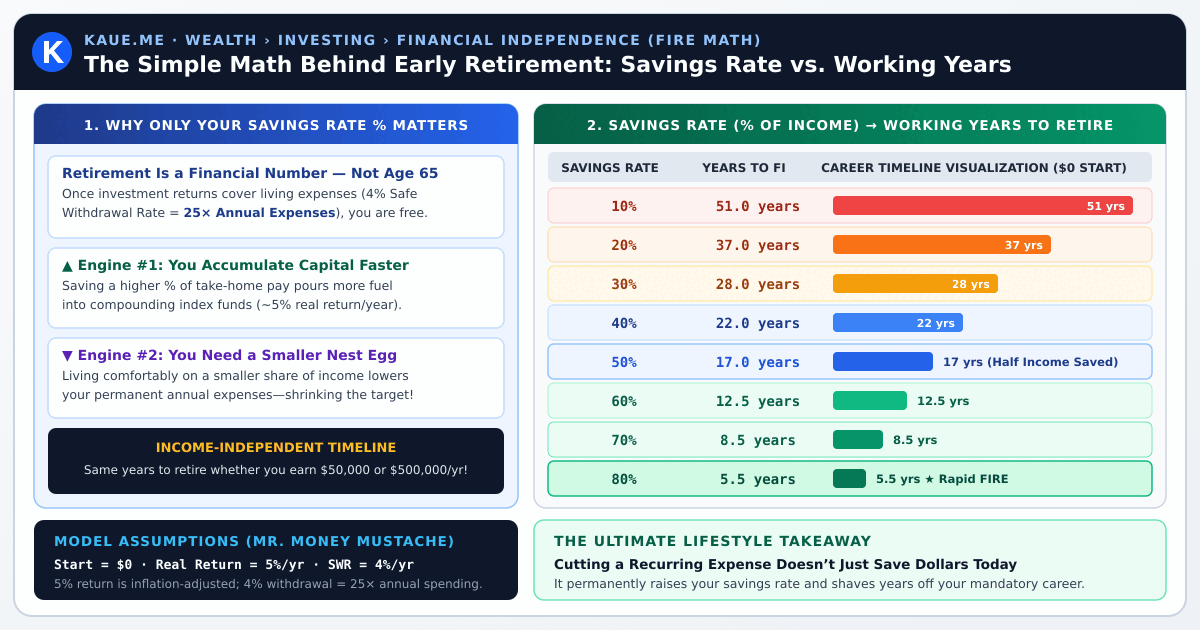
When most people think of retirement, they picture an age—usually somewhere around 65. But retirement isn’t an age; it’s a financial number. Once your investments generate enough income to cover your living expenses, you are financially independent.
The time it takes to reach that milestone—famously popularized in the financial independence community by Pete Adeney (Mr. Money Mustache) in The Shockingly Simple Math Behind Early Retirement—is determined by a surprisingly simple mathematical concept. It doesn’t primarily depend on how much money you make. It depends on just one core metric: your savings rate.
Your savings rate is the percentage of your take-home pay that you save and invest rather than spend.
Focusing on this percentage is incredibly powerful because increasing your savings rate attacks the retirement math from two distinct angles:
As soon as your invested money generates enough returns to pay for your living expenses (while keeping pace with inflation), you no longer need to work for a paycheck.
To see this math in action, we can look at how different savings rates impact the timeline to financial independence.
The table below assumes you are starting with a net worth of zero, investing your savings into broad market index funds with an inflation-adjusted return of about 5% per year, and planning to live off a safe withdrawal rate of 4% per year during retirement.
| Savings Rate (% of Income) | Estimated Working Years to Retire |
|---|---|
| 10% | 51 years |
| 20% | 37 years |
| 30% | 28 years |
| 40% | 22 years |
| 50% | 17 years |
| 60% | 12.5 years |
| 70% | 8.5 years |
| 80% | 5.5 years |
(Note: Because this is based on percentages, these timelines hold true whether you earn $50,000 or $500,000 a year.)
If you save the standard 10% to 20% of your income, you are on track for a traditional, decades-long career. There is absolutely nothing wrong with that path.
However, if you want to buy back your time and retire early, the math shows exactly how to do it. By optimizing your lifestyle to live on less, you drastically reduce the time you need to spend in the mandatory workforce. Every time you cut a recurring expense, you aren’t just saving money today—you are permanently shaving years off your required working life.
Get the curated offline edition of Kaue's Way of Life—a practical field guide to optimizing 🍏 Health, 💰 Wealth, ❤️ Love, and 🧘 Meaning.
Have a question, perspective, or suggestion? Share your thoughts below. Comments are powered by GitHub Discussions (ad-free and spam-free)—click Sign in with GitHub below to comment or react (creating a free GitHub account takes less than a minute).
Updated on Oct 11, 2026.
DISCLAIMER: The content on this site is for informational and educational purposes only and does not constitute medical, psychological, financial, investment, tax, or legal advice. The ideas, curation, and opinions presented here are my own and do not represent those of my employer. Book, lecture, and article summaries are independent educational commentary and remain the intellectual property of their respective authors. AI tools may be used to assist with editing, formatting, and synthesis; while every effort is made to ensure accuracy, errors may occur. PRIVACY: This site uses third-party services for comments (giscus / GitHub Discussions) and embedded media (YouTube), which may process visitor IP addresses and cookies in accordance with their respective privacy policies.