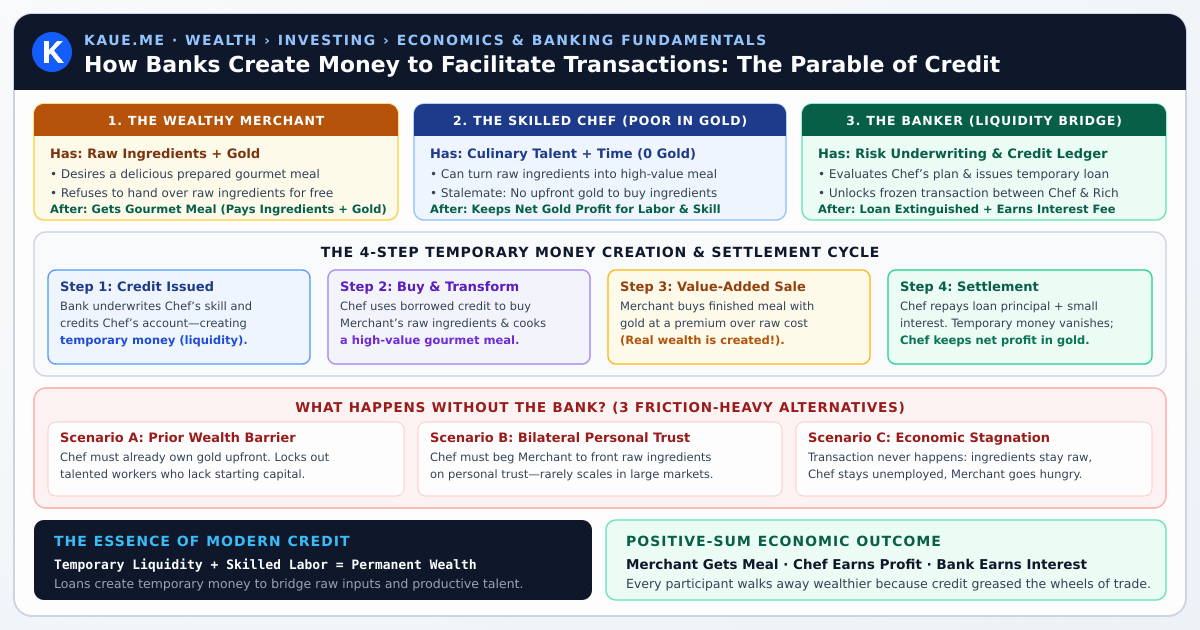
Have you ever wondered how banks actually add value to the economy? At first glance, it might seem like they just shuffle money around and take a cut. But in reality, the fundamental purpose of banking is to facilitate transactions that would otherwise be impossible.
To understand how credit and money creation actually build wealth, let’s look at a simple economic parable.
Imagine a local economy with three key players:
The Chef knows they can turn the Merchant’s raw ingredients into a fantastic meal that the Merchant would gladly pay a premium for. However, the Merchant isn’t willing to just hand over their ingredients for free, and the Chef has no gold to buy them upfront.
We have an economic stalemate. The potential for value creation is there, but there is no liquidity to bridge the gap.
Enter the Banker. The Chef goes to the bank, explains their business plan, and asks for a short-term loan. The bank evaluates the Chef’s skills, deems it a safe bet, and issues a loan. In modern banking terms, the bank simply credits the Chef’s account—essentially creating temporary money to facilitate this specific economic activity.
With the newly created credit, the economy springs into action:
Now flush with gold from a successful sale, the Chef goes back to the Banker. They repay the original loan amount, plus a small interest fee for the service. The temporary money is destroyed, but real wealth has been created.
Everyone walks away from this transaction better off than when they started:
If we remove the bank from this equation, we are left with a few alternatives to avoid a bank loan. Unfortunately, they all make economic progress much more difficult:
This simple example illustrates the core function of credit. Banks don’t just hoard money; they create the temporary liquidity required to turn potential value into tangible wealth. By bridging the gap between raw resources and skilled labor, they grease the wheels of commerce and allow transactions to flourish.
Get the curated offline edition of Kaue's Way of Life—a practical field guide to optimizing 🍏 Health, 💰 Wealth, ❤️ Love, and 🧘 Meaning.
Have a question, perspective, or suggestion? Share your thoughts below. Comments are powered by GitHub Discussions (ad-free and spam-free)—click Sign in with GitHub below to comment or react (creating a free GitHub account takes less than a minute).
Updated on Oct 11, 2026.
DISCLAIMER: The content on this site is for informational and educational purposes only and does not constitute medical, psychological, financial, investment, tax, or legal advice. The ideas, curation, and opinions presented here are my own and do not represent those of my employer. Book, lecture, and article summaries are independent educational commentary and remain the intellectual property of their respective authors. AI tools may be used to assist with editing, formatting, and synthesis; while every effort is made to ensure accuracy, errors may occur. PRIVACY: This site uses third-party services for comments (giscus / GitHub Discussions) and embedded media (YouTube), which may process visitor IP addresses and cookies in accordance with their respective privacy policies.