A personal approach to building long-term wealth through simplicity, low costs, and global diversification.
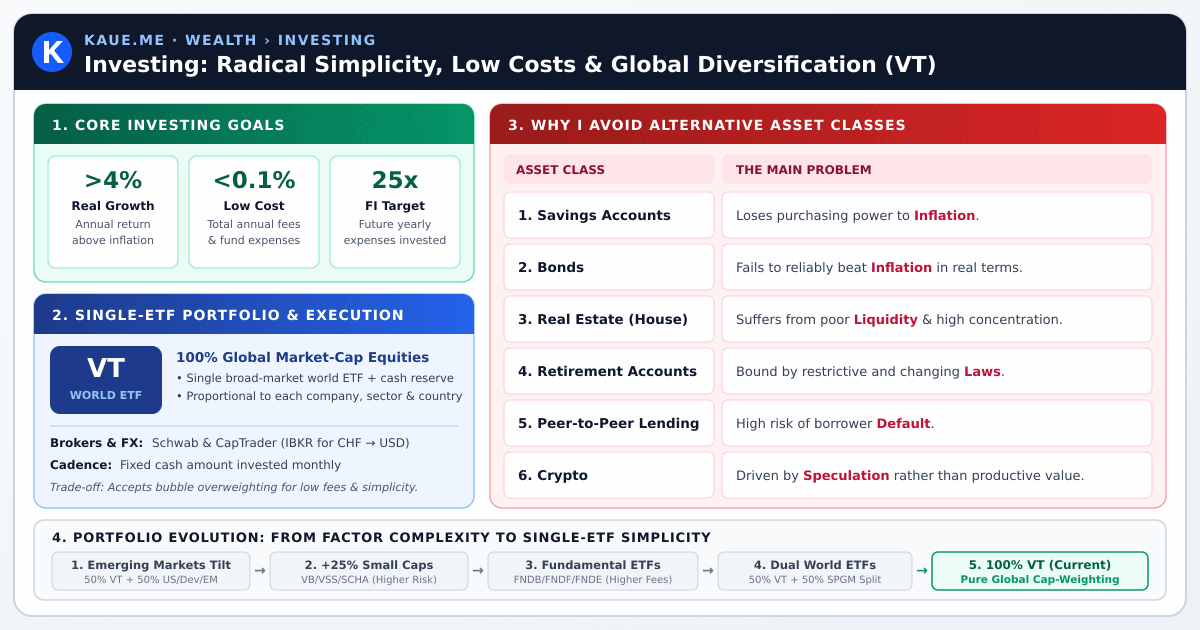
My current strategy prioritizes radical simplicity, using a single broad-market Exchange Traded Fund (ETF) alongside a cash emergency fund.
The Core ETF:
| Region Focus | Ticker |
|---|---|
| World | VT |
Market-cap weighted funds provide massive global diversification at an incredibly low cost. By weighting by market cap, the invested money is naturally proportional to the actual market value of each company, sector, and country.
The Trade-off: The downside of market-cap weighting is that when a company, sector, or country is overpriced (e.g., during a market bubble), the fund automatically buys more of it. Conversely, it buys less of underpriced assets. For me, the simplicity and low fees outweigh this drawback.
Here is a quick look at why I prioritize global equities over other common asset classes:
| Asset Class | The Main Problem |
|---|---|
| Savings Accounts | Loses purchasing power to Inflation. |
| Bonds | Fails to reliably beat Inflation in real terms. |
| Real Estate (House) | Suffers from poor Liquidity. |
| Retirement Accounts | Bound by restrictive and changing Laws. |
| Peer-to-peer Lending | High risk of borrower Default. |
| Crypto | Driven by Speculation rather than productive value. |
Over the years, my strategy has evolved from complex factor-weighting back to pure simplicity. Here is a brief history of my past portfolio experiments and why I changed them.
Over time, I systematically stripped away the complexity:
Get the curated offline edition of Kaue's Way of Life—a practical field guide to optimizing 🍏 Health, 💰 Wealth, ❤️ Love, and 🧘 Meaning.
Have a question, perspective, or suggestion? Share your thoughts below. Comments are powered by GitHub Discussions (ad-free and spam-free)—click Sign in with GitHub below to comment or react (creating a free GitHub account takes less than a minute).
Updated on Oct 11, 2026.
DISCLAIMER: The content on this site is for informational and educational purposes only and does not constitute medical, psychological, financial, investment, tax, or legal advice. The ideas, curation, and opinions presented here are my own and do not represent those of my employer. Book, lecture, and article summaries are independent educational commentary and remain the intellectual property of their respective authors. AI tools may be used to assist with editing, formatting, and synthesis; while every effort is made to ensure accuracy, errors may occur. PRIVACY: This site uses third-party services for comments (giscus / GitHub Discussions) and embedded media (YouTube), which may process visitor IP addresses and cookies in accordance with their respective privacy policies.