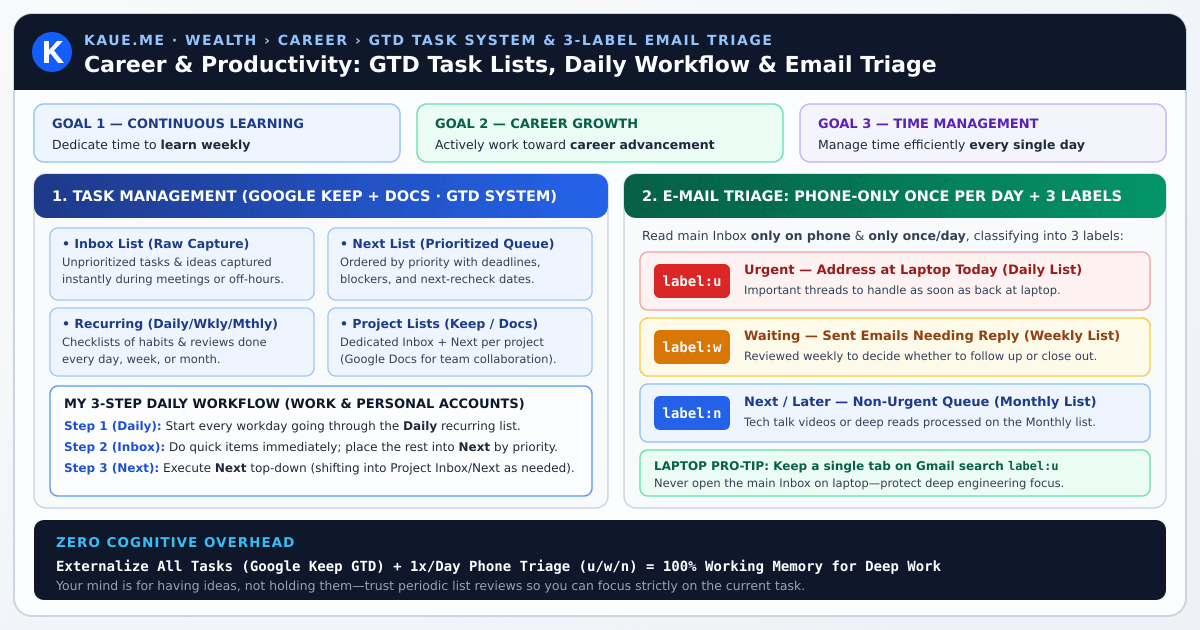
I write down all tasks so I can free up my working memory to focus strictly on the current task. I trust that my system will remind me to review other tasks periodically. This approach is heavily inspired by David Allen’s book, Getting Things Done.
I use Google Keep for notes because it is seamlessly convenient to edit on both my laptop and phone. I maintain several core lists:
Inbox: Lists unprioritized tasks and raw ideas. For example, if I have an idea outside of working hours or during a meeting, it goes straight to the Inbox.
Next: Tasks ordered by priority. These can include extra context such as deadlines, what is blocking the task, and by which date I should recheck it.
Recurring (Daily / Weekly / Monthly): Routines and tasks I must do every day, week, or month.
Project Lists: Individual projects get their own Inbox and Next lists. For some collaborative projects, I use Google Docs for these lists (better for collaboration, though slightly less convenient on mobile).
My Daily Workflow:
I start every workday going over the Daily list.
Next, I process the Inbox: I do the quick items immediately, and move the rest to prioritized spots in the Next list.
Finally, I work through the Next list. If a task requires working on a specific project, I shift over to that project’s specific Inbox/Next lists.
(Note: I use an analogous list system for my personal life on my personal Google account.)
I read my e-mail inbox only on my phone and only once per day. I classify e-mails so I can deal directly with the important ones when I’m back at my laptop.
I use 3 simple Gmail labels:
🔴 u (Urgent): For e-mails I want to address as soon as I get to my laptop. Processing these is a dedicated task on my Daily list.
🟡 w (Waiting): For e-mails I send that need an answer. Reviewing these is on my Weekly list to decide if I should follow up or give up.
🔵 n (Next/Later): For e-mails I want to address later (e.g., watching a video of a tech talk). Processing these is a task on my Monthly list.
Pro-tip: On my laptop, I keep a single browser tab open with label:u Gmail search results to see when someone replies to an important thread. I avoid looking at the main Inbox from my laptop to preserve that time for more important tasks.
📝 Beyond the Paycheck: A Framework for Meaningful Work Inspired by Paul Graham's essay on the intersection of passion and career, here is a framework for unlearning bad habits and navigating toward work that actually energizes you.
📝 How to Do Work That Matters: Lessons from Richard Hamming In his famous talk, 'You and Your Research,' Richard Hamming distilled his observations into a masterclass on the traits, habits, and mindsets that separate good work from truly great achievements.
📝 The Ultimate Guide to Stress-Free Task Management Our brains are excellent at creating ideas, but terrible at storing them. Here is a five-step framework for managing your workflow and reclaiming your peace of mind.
📝 7 Undeniable Traits of Future High-Achievers Sustained success rarely happens by accident. Here are seven undeniable habits, mindsets, and behaviors that indicate you are wired for long-term success.
📝 Why Individual Contributors Hit Roadblocks (And How to Keep Moving) As an Individual Contributor in tech, the path to seniority isn't just about writing better code. Here are the common behavioral traps and friction points that cause ICs to get stuck and how to navigate them.
📝 Max Dama on Automated Trading - Brain Teasers (Enhanced Edition) An original study guide and worked solution set for quantitative trading brain teasers inspired by Max Dama's automated trading notes, covering market making, Kelly betting, probability, mental math, and logic.
📝 Cracking the IQ Test: 18 Questions, Answers, and Explanations An analytical walkthrough of 18 cognitive reasoning puzzles—covering verbal classification, analogies, number sequences, spatial rotation, and formal syllogisms—with step-by-step explanations.
📝 Summary: The Feynman Lectures on Physics – Algebra A summary of Chapter 22, Volume I of The Feynman Lectures on Physics, exploring how mathematical rules can be abstracted and generalized from counting to Euler's formula.
📝 The Career Bet: Choosing Your Prize vs. Your Odds Every major career decision is a calculated wager between the size of your prize and your percentage chance of winning. Here is how to set the dials as your bankroll grows.
📝 Pareto Salary: Price's Law and Compensation If the square root of people produce half the value under Price's Law, how many times higher than the average salary should top performers be compensated as a company scales?
📝 One Order of Time Faster: The 3x to 5x Rule of Leverage If you were one order of time faster than someone else—delivering monthly work in a week or quarterly work in a month—you need to be 3x to 5x faster through leverage, not brute force.
📝 The Elegance of Euler: My Favorite Mathematical Formulas Leonhard Euler had an unparalleled ability to build bridges between seemingly unrelated areas of mathematics. Here is a collection of my favorite Euler formulas and divergent series.
📝 Unit Testing: Commands vs Mocks in Go How to handle external dependencies in Go unit tests—comparing moving code to main, dependency injection with mocks, and the Command Pattern.
📝 Exploring the Expression Problem in Go with Generics How to approach the Expression Problem in Go using generics, referencing the Featherweight Go paper and examining the limitations of struct-level type constraints.
📝 Get Sorted Keys From Map in Go Using Generics How to implement a clean, reusable generic function in Go that extracts and returns sorted keys from any map using cmp.Ordered and slices.Sort.
📝 FizzBuzz in Too Much Detail: A Go Perspective How to progressively refactor FizzBuzz in Go, from basic conditionals to data-driven structs, closures, higher-order functions, and concurrency with channels.
📝 4 Game-Changing Lessons from 'Software Engineering at Google' Fergus Henderson’s widely read paper, Software Engineering at Google, offers a fascinating look at the engineering culture, tools, and processes that allow teams to manage complexity and maintain code health over time.
📝 The Strategy Illusion: Are You Making Plans or Just Making Wishes? Most organizations don't actually have a strategy—they have a wish list of goals. True strategy, as pioneered by Richard Rumelt, requires diagnosing reality, setting a guiding policy, and coordinating coherent actions.
📝 The Mechanics of Startup Wealth: Value, Scale, and Effort Many people dream of achieving significant financial independence, but few understand how extreme wealth is generated through value creation, measurement, and leverage.
📝 How to Find and Validate Business Ideas Customers Actually Want We often fall in love with our own ideas, assuming that if we build it, customers will follow. Here is a practical guide to finding and validating business ideas that people are eager to pay for.
Have a question, perspective, or suggestion? Share your thoughts below. Comments are powered by GitHub Discussions (ad-free and spam-free)—click Sign in with GitHub below to comment or react (creating a free GitHub account takes less than a minute).
DISCLAIMER: The content on this site is for informational and educational purposes only and does not constitute medical, psychological, financial, investment, tax, or legal advice. The ideas, curation, and opinions presented here are my own and do not represent those of my employer. Book, lecture, and article summaries are independent educational commentary and remain the intellectual property of their respective authors. AI tools may be used to assist with editing, formatting, and synthesis; while every effort is made to ensure accuracy, errors may occur. PRIVACY: This site uses third-party services for comments (giscus / GitHub Discussions) and embedded media (YouTube), which may process visitor IP addresses and cookies in accordance with their respective privacy policies.