It’s the most universally accepted moral rule in human history: murder is wrong. But if someone were to ask you to prove it, how would you do it?
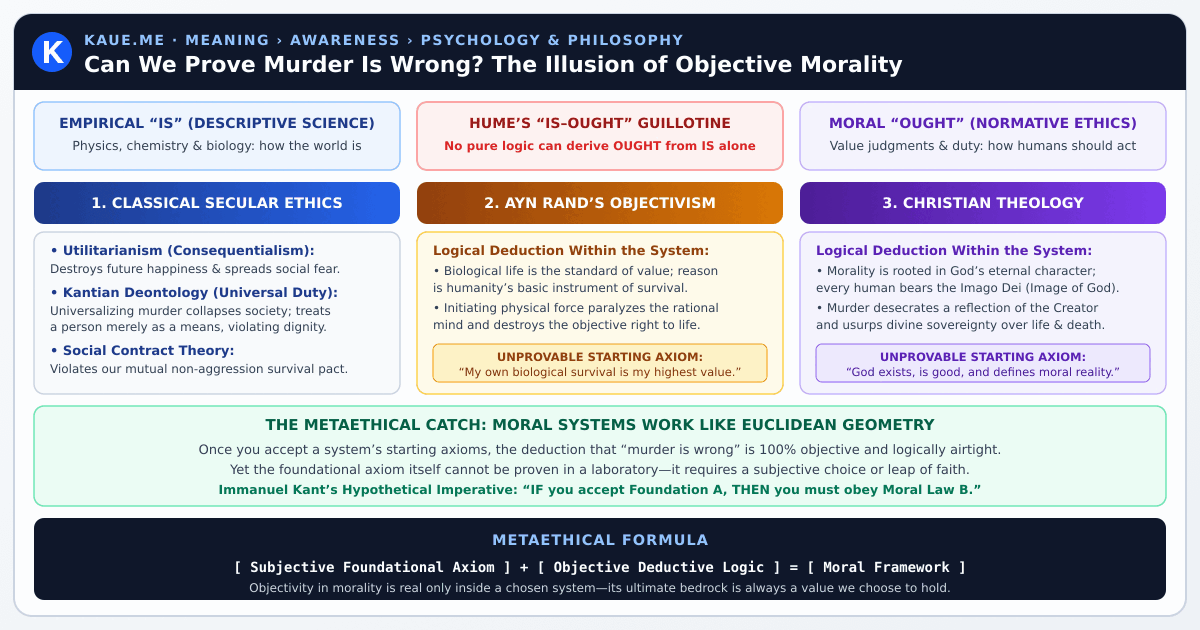
Unlike gravity or mathematics, you can’t put morality in a test tube. You can’t empirically prove a moral claim in a laboratory. The Scottish philosopher David Hume famously identified this as the “Is-Ought Problem”—you cannot logically deduce how humans ought to behave solely from scientific facts about how the world is.
Because empirical proof is impossible, philosophers and theologians have spent centuries building elaborate frameworks to logically deduce the wrongness of murder. Let’s look at a few, and then look at the ultimate “catch” that undermines them all.
Philosophers usually tackle this by starting from different logical premises:
But what happens when we look at more rigid, absolute systems?
Consider two drastically different worldviews that both claim absolute, objective morality: Christianity and Ayn Rand’s Objectivism.
The Objectivist argues that morality is grounded in the objective requirements of human survival. Because a human’s ultimate value is their own biological life, and their basic tool for survival is reason, initiating physical force against someone (including murder) is the ultimate moral evil. It destroys life and paralyzes the rational mind. Therefore, murder violates the fundamental, objective right to life.
The Christian argues that ethics are grounded in the eternal character of God. Because every human is made in the image of God (Imago Dei), human life has sacred value. Murder is wrong because it desecrates a reflection of the Creator, violently usurps God’s sovereign authority over life and death, and breaks a direct divine command.
Both the Objectivist and the Christian will emphatically state: “In my system, murder is objectively wrong.”
Here is the realization that unravels the “objectivity” of both systems: Objectivity in morality is an illusion built on subjective foundations.
Saying “in Christianity, murder is objectively wrong” is logically identical to saying “in Objectivism, murder is objectively wrong.” Both frameworks function exactly like geometry. Once you accept the starting axioms, the rules that follow are rigidly objective and logically sound.
But what about the axioms themselves?
Neither of these foundational premises can be empirically proven. They require a subjective leap — either a leap of faith or a philosophic choice. If you reject the Christian God, or if you decide you value something more than your biological survival, the “objective” rule against murder collapses.
Immanuel Kant called these hypothetical imperatives: If you accept A, then you must do B.
Every major moral system fundamentally functions this way. No one has ever successfully bridged David Hume’s “Is-Ought” gap without smuggling in at least one unprovable, subjective assumption. We all agree that murder is wrong, but our “proofs” are only as strong as the subjective beliefs we choose to build them on.
Get the curated offline edition of Kaue's Way of Life—a practical field guide to optimizing 🍏 Health, 💰 Wealth, ❤️ Love, and 🧘 Meaning.
Have a question, perspective, or suggestion? Share your thoughts below. Comments are powered by GitHub Discussions (ad-free and spam-free)—click Sign in with GitHub below to comment or react (creating a free GitHub account takes less than a minute).
Updated on Oct 5, 2026.
DISCLAIMER: The content on this site is for informational and educational purposes only and does not constitute medical, psychological, financial, investment, tax, or legal advice. The ideas, curation, and opinions presented here are my own and do not represent those of my employer. Book, lecture, and article summaries are independent educational commentary and remain the intellectual property of their respective authors. AI tools may be used to assist with editing, formatting, and synthesis; while every effort is made to ensure accuracy, errors may occur. PRIVACY: This site uses third-party services for comments (giscus / GitHub Discussions) and embedded media (YouTube), which may process visitor IP addresses and cookies in accordance with their respective privacy policies.