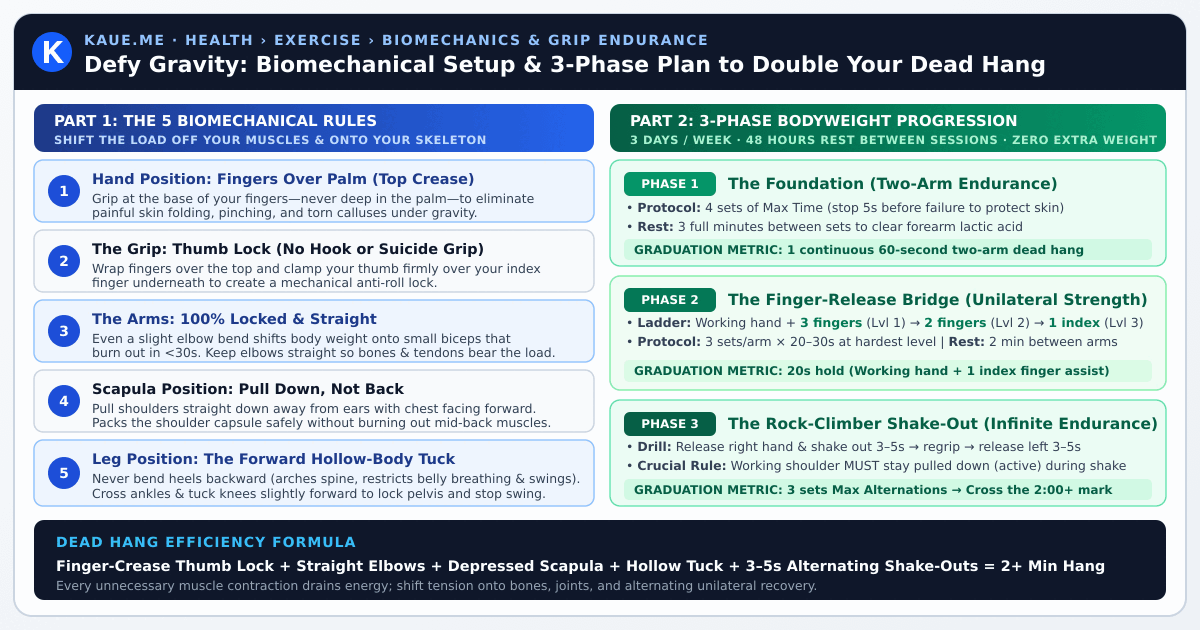
Maximizing your time on a pull-up bar is not just about having a vice-like grip. It is an exercise in extreme mechanical efficiency. Every unnecessary muscle contraction drains energy, and every millimeter of skin slippage brings you closer to failure.
If you are training on a standard, fixed (non-rotating) bar, here is the exact biomechanical setup and bodyweight-only training plan to double your hang time.
To stay on the bar longer, you must shift the load off your muscles and onto your skeletal structure.
Do not grip the bar deep in the middle of your palm. As gravity pulls you down, the fleshy pad of your palm will fold and pinch against the bar, causing agonizing skin pain and torn calluses.
The Fix: Grip the bar right at the base of your fingers (the top crease of your palm). This eliminates the skin fold.
A weightlifting “hook grip” (crushing your fingers over your thumb) will cause excruciating joint pain during a long hold, and a thumbless “suicide grip” forces your forearms to overwork.
The Fix: Wrap your fingers over the top of the bar, and wrap your thumb firmly underneath. Clamp your thumb down over your index finger to create a mechanical lock that prevents the bar from rolling.
Bending your elbows — even slightly — shifts your body weight onto your biceps. Your biceps are relatively small muscles that will burn out in under 30 seconds.
The Fix: Keep your arms completely straight. Let your bones and connective tissue bear the weight.
You must maintain an “active” shoulder to protect your joint capsule, but pulling your shoulder blades aggressively back (like you are doing a chest-to-bar pull-up) will rapidly burn out your mid-back muscles.
The Fix: Simply pull your shoulders straight down, away from your ears. Keep your chest facing directly forward, not angled up at the ceiling. This engages the lats just enough to pack the joint with minimal energy cost.
If the bar is low and you have to bend your legs, never bend your heels backward behind you. Arching your back forces your ribs open, restricts deep belly breathing, and induces a pendulum swing.
The Fix: Cross your ankles and tuck your knees slightly in front of you. This tilts your pelvis into a hollow-body position, locking down your core and stabilizing your entire torso so you don’t swing.
To hold onto the bar longer, you eventually need to learn the “shake-out” — the rock climber’s technique of hanging from one arm while shaking the lactic acid out of the other.
This 3-phase program requires zero extra weight and uses a finger-release method to safely build unilateral (one-arm) strength. Train 3 days per week, resting 48 hours between sessions.
Your goal is to build raw capacity and condition the skin on your hands.
| Workout Protocol | Details |
|---|---|
| Working Sets | 4 sets of Max Time. Stop 5 seconds before complete failure to avoid skin tears. |
| Rest Between Sets | 3 full minutes. (Forearms need time to clear lactic acid). |
| Graduation Metric | A single continuous 60-second two-arm hang. |
This phase safely transfers your weight to a single arm without requiring a towel or weight belt.
| Workout Protocol | Details |
|---|---|
| The Setup | Grip the bar with both hands. Your “working hand” holds normally. On your “assist hand,” you will slowly remove fingers to shift the load. |
| Level 1 | Working hand + 3 fingers of assist hand. |
| Level 2 | Working hand + 2 fingers of assist hand (index/middle). |
| Level 3 | Working hand + 1 finger of assist hand (index only). |
| Working Sets | 3 sets per arm of 20-30 seconds at the hardest level you can manage. |
| Rest Between Sets | 2 minutes between arms. |
| Graduation Metric | A 20-second hold using your working hand + only the index finger of your assist hand. |
You now have the structural integrity to hold a one-arm hang. The goal is to cycle the fatigue back and forth.
| Workout Protocol | Details |
|---|---|
| The Drill | Hang with two hands. Let go with the right hand, shake it out for exactly 3 to 5 seconds. Grab the bar. Let go with the left hand, shake it out for 3 to 5 seconds. |
| Crucial Rule | Your working shoulder MUST stay pulled down (active) while the other arm rests. Do not let your shoulder shrug into your ear. |
| Working Sets | 3 sets of Max Alternations. Count total “shakes” before dropping. |
| Graduation Metric | Cycle rests continuously until you cross the 2-minute mark. |
Get the curated offline edition of Kaue's Way of Life—a practical field guide to optimizing 🍏 Health, 💰 Wealth, ❤️ Love, and 🧘 Meaning.
Have a question, perspective, or suggestion? Share your thoughts below. Comments are powered by GitHub Discussions (ad-free and spam-free)—click Sign in with GitHub below to comment or react (creating a free GitHub account takes less than a minute).
Updated on Oct 9, 2026.
DISCLAIMER: The content on this site is for informational and educational purposes only and does not constitute medical, psychological, financial, investment, tax, or legal advice. The ideas, curation, and opinions presented here are my own and do not represent those of my employer. Book, lecture, and article summaries are independent educational commentary and remain the intellectual property of their respective authors. AI tools may be used to assist with editing, formatting, and synthesis; while every effort is made to ensure accuracy, errors may occur. PRIVACY: This site uses third-party services for comments (giscus / GitHub Discussions) and embedded media (YouTube), which may process visitor IP addresses and cookies in accordance with their respective privacy policies.