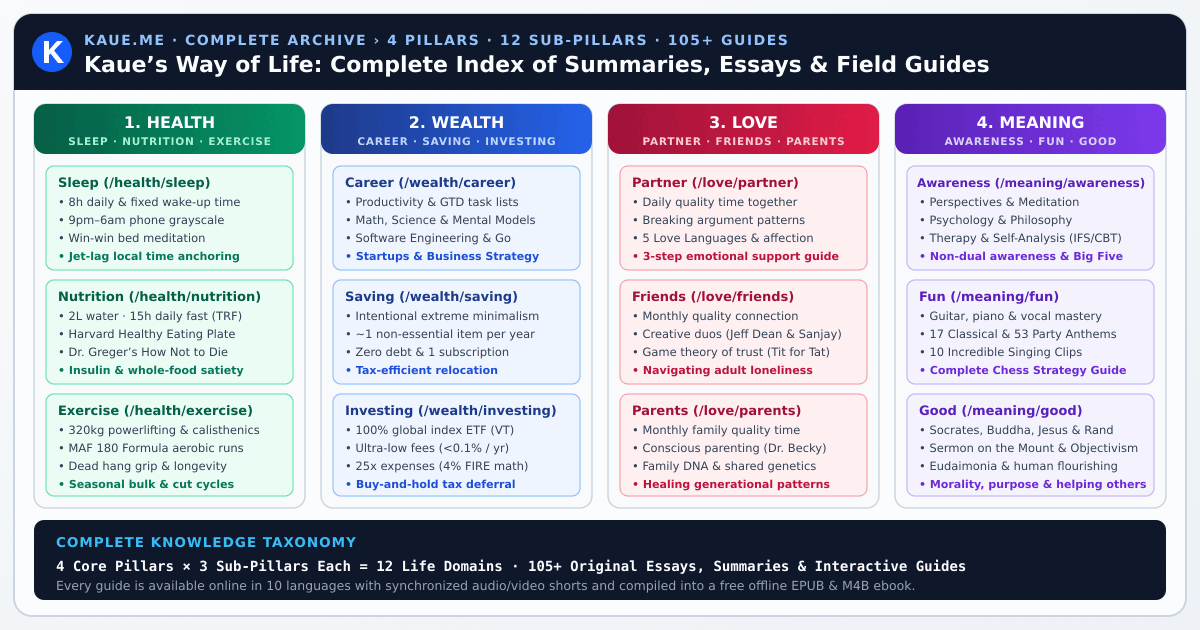
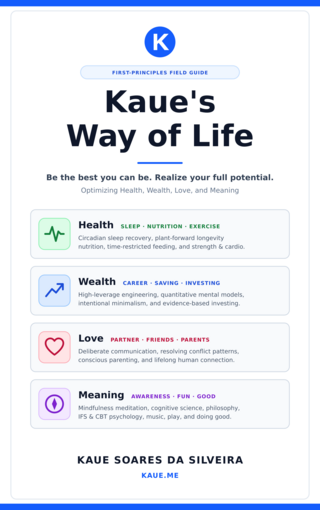
Welcome to the complete index of summaries, essays, and notes on living a balanced life. Content is structured around four core pillars: Health, Wealth, Love, and Meaning.
📝 Key Takeaways from Matthew Walker's 'Why We Sleep' at Talks at Google In his popular 'Talks at Google' presentation, neuroscientist and sleep researcher Matthew Walker discusses the profound impact that sleep has on our minds and bodies, arguing that sleep is a non-negotiable biological necessity.
📝 Why All Calories Are Not Created Equal: How We Got the Science of Weight Loss Wrong In Why Calories Don't Count: How We Got the Science of Weight Loss Wrong, Cambridge geneticist Dr. Giles Yeo dismantles the traditional calorie-counting model and explains why caloric availability, protein, and fiber matter far more than raw label numbers.
📝 Book & Talk Summary: 'How Not to Die' by Dr. Michael Greger In his popular 'Talks at Google' presentation, Dr. Michael Greger outlined the core concepts of his best-selling book, How Not to Die, focusing on how diet and lifestyle choices can prevent and reverse chronic disease.
📝 StrongLifts 5x5 Workout and App: A Long-Term Review When it comes to building raw strength and muscle, complexity is often the enemy of progress. Here is my long-term review of the StrongLifts 5x5 workout program, companion app, and personal modifications.
📝 Defy Gravity: How to Maximize Your Dead Hang Duration Maximizing your time on a pull-up bar is not just about having a vice-like grip. It is an exercise in extreme mechanical efficiency. Every unnecessary muscle contraction drains energy, and every millimeter of skin slippage brings you closer to failure.
📝 Beyond the Paycheck: A Framework for Meaningful Work Inspired by Paul Graham's essay on the intersection of passion and career, here is a framework for unlearning bad habits and navigating toward work that actually energizes you.
📝 How to Do Work That Matters: Lessons from Richard Hamming In his famous talk, 'You and Your Research,' Richard Hamming distilled his observations into a masterclass on the traits, habits, and mindsets that separate good work from truly great achievements.
📝 The Ultimate Guide to Stress-Free Task Management Our brains are excellent at creating ideas, but terrible at storing them. Here is a five-step framework for managing your workflow and reclaiming your peace of mind.
📝 7 Undeniable Traits of Future High-Achievers Sustained success rarely happens by accident. Here are seven undeniable habits, mindsets, and behaviors that indicate you are wired for long-term success.
📝 Why Individual Contributors Hit Roadblocks (And How to Keep Moving) As an Individual Contributor in tech, the path to seniority isn't just about writing better code. Here are the common behavioral traps and friction points that cause ICs to get stuck and how to navigate them.
📝 Max Dama on Automated Trading - Brain Teasers (Enhanced Edition) An original study guide and worked solution set for quantitative trading brain teasers inspired by Max Dama's automated trading notes, covering market making, Kelly betting, probability, mental math, and logic.
📝 Cracking the IQ Test: 18 Questions, Answers, and Explanations An analytical walkthrough of 18 cognitive reasoning puzzles—covering verbal classification, analogies, number sequences, spatial rotation, and formal syllogisms—with step-by-step explanations.
📝 Summary: The Feynman Lectures on Physics – Algebra A summary of Chapter 22, Volume I of The Feynman Lectures on Physics, exploring how mathematical rules can be abstracted and generalized from counting to Euler's formula.
📝 The Career Bet: Choosing Your Prize vs. Your Odds Every major career decision is a calculated wager between the size of your prize and your percentage chance of winning. Here is how to set the dials as your bankroll grows.
📝 Pareto Salary: Price's Law and Compensation If the square root of people produce half the value under Price's Law, how many times higher than the average salary should top performers be compensated as a company scales?
📝 One Order of Time Faster: The 3x to 5x Rule of Leverage If you were one order of time faster than someone else—delivering monthly work in a week or quarterly work in a month—you need to be 3x to 5x faster through leverage, not brute force.
📝 The Elegance of Euler: My Favorite Mathematical Formulas Leonhard Euler had an unparalleled ability to build bridges between seemingly unrelated areas of mathematics. Here is a collection of my favorite Euler formulas and divergent series.
📝 Unit Testing: Commands vs Mocks in Go How to handle external dependencies in Go unit tests—comparing moving code to main, dependency injection with mocks, and the Command Pattern.
📝 Exploring the Expression Problem in Go with Generics How to approach the Expression Problem in Go using generics, referencing the Featherweight Go paper and examining the limitations of struct-level type constraints.
📝 Get Sorted Keys From Map in Go Using Generics How to implement a clean, reusable generic function in Go that extracts and returns sorted keys from any map using cmp.Ordered and slices.Sort.
📝 FizzBuzz in Too Much Detail: A Go Perspective How to progressively refactor FizzBuzz in Go, from basic conditionals to data-driven structs, closures, higher-order functions, and concurrency with channels.
📝 4 Game-Changing Lessons from 'Software Engineering at Google' Fergus Henderson’s widely read paper, Software Engineering at Google, offers a fascinating look at the engineering culture, tools, and processes that allow teams to manage complexity and maintain code health over time.
📝 The Strategy Illusion: Are You Making Plans or Just Making Wishes? Most organizations don't actually have a strategy—they have a wish list of goals. True strategy, as pioneered by Richard Rumelt, requires diagnosing reality, setting a guiding policy, and coordinating coherent actions.
📝 The Mechanics of Startup Wealth: Value, Scale, and Effort Many people dream of achieving significant financial independence, but few understand how extreme wealth is generated through value creation, measurement, and leverage.
📝 How to Find and Validate Business Ideas Customers Actually Want We often fall in love with our own ideas, assuming that if we build it, customers will follow. Here is a practical guide to finding and validating business ideas that people are eager to pay for.
📝 The Simple Math Behind Early Retirement Retirement isn't an age; it's a financial number. Discover why the time it takes to reach financial independence depends on one core metric: your savings rate.
📝 Navigating Child Discipline: A Look at Structured Time-Outs While the time-out remains a popular parenting tool, child behavior specialists emphasize that how a time-out is implemented matters just as much as using it in the first place.
📝 How to Support an Upset Partner or Child: A 3-Step Guide When a partner or child is deeply upset, rushing to solve the issue can leave them feeling unheard. Here is a three-stage framework for supporting loved ones through intense emotions.
📝 How to Break Free from Common Argument Patterns in Relationships Arguments in relationships often follow predictable, frustrating loops. By understanding a few core psychological dynamics—drawing on insights from relationship therapist Esther Perel—you can shift from a cycle of accusation to one of connection.
📝 Your Mind is an Excellent Servant, but a Terrible Master An exploration of David Foster Wallace's 2005 Kenyon commencement address ('This is Water') on conscious attention, overcoming default self-centeredness, and choosing what we worship.
📝 The Headless Way: A Guided Meditation An experiential guide to the classic Pointing Experiment based on the teachings of Douglas Harding and Richard Lang.
📝 Shamil Chandaria: The Bayesian Brain and Meditation A predictive processing account of radical changes in phenomenal experience, awakening, enlightenment, and liberation based on Shamil Chandaria's lecture.
📝 From Math to Memes: The Surprising Origins of '-Maxxing' If you've spent any time on the internet recently, you've probably seen someone talking about optimizing their life. Maybe a finance bro is talking about 'token maxing' their crypto portfolio. Maybe a TikToker is sharing a 'looksmaxxing' routine. Or maybe a gamer is talking about their 'min-maxed' character build. Let's look at how a 1920s mathematical theory mutated into ubiquitous internet slang.
📝 The Prison of the Mind: How to Stop Shooting the 'Second Arrow' Our minds that act as filters. We label our experiences, and in doing so, we often build mental cages of our own design. This concept is the bedrock of Stoic philosophy, modern Cognitive Behavioral Therapy (CBT), and an ancient Buddhist teaching that gives us a perfect metaphor for human suffering: The Parable of the Two Arrows.
📝 The Ultimate Ultimatum: What Happens When We Refuse to 'Choose Life'? Comparing how Ayn Rand's secular philosophy of Objectivism and the ancient tenets of Christianity define the fundamental 'choice to live'—and the vastly different consequences they outline for refusing it.
📝 The Ultimate Goal: How the World's Four Major Religions Seek Liberation How the four major world religions—Christianity, Islam, Hinduism, and Buddhism—understand the human predicament and the path to ultimate liberation, with a breakdown of essential theological and philosophical terms.
📝 The History of Western Philosophy: Thales to Aquinas A comprehensive summary of the foundational thinkers of Western civilization—from the Pre-Socratics, Socrates, Plato, and Aristotle to Thomas Aquinas—based on the lectures of Leonard Peikoff.
📝 The Unexpected Harmony: Unifying Ayn Rand and the Sermon on the Mount At first glance, attempting to unify Ayn Rand’s Objectivism with Jesus of Nazareth’s Sermon on the Mount seems like an impossible paradox. Rand famously regarded the Sermon as the ultimate blueprint for the 'evil' of altruism, while traditional theologians often view Rand's exaltation of rational selfishness and pride as inherently sinful.
📝 Can We Actually Prove Murder is Wrong? The Illusion of Objective Morality It’s the most universally accepted moral rule in human history: murder is wrong. But if someone were to ask you to prove it, how would you do it? Because empirical proof is impossible, philosophers and theologians have spent centuries building elaborate frameworks to logically deduce the wrongness of murder. Let's look at a few, and then look at the ultimate 'catch' that undermines them all.
📝 Beyond the Ego: How Healthy Pride and True Humility Coexist (and Create Better Leaders) We use one word ”pride” to describe both dangerous narcissism and the profound joy a parent feels for their child. By untangling these definitions, we can understand not only how a healthy sense of pride coexists with true humility, but how together they form the bedrock of the most effective leadership model in both theology and modern business: Servant Leadership.
📝 The Biological OS: Mapping Human Consciousness to Computer Architecture Have you ever wondered how your brain manages to process the blinding complexity of reality while your conscious mind struggles to remember a six-digit verification code? If we look at cognitive science through the lens of computer architecture, the answer becomes surprisingly clear: **Consciousness is located in the processor. Everything else is unconscious computation.** By placing consciousness squarely in the CPU and defining the rest of the brain's activity as background processes, we can map out the human mind using standard computer hardware concepts. Here is a deep dive into how your 'Biological OS' handles daily tasks, software bugs, system maintenance, and altered states.
📝 Internal Family Systems (IFS) Explained: A Guide to "Parts Work" An accessible breakdown of the neuroscience and psychology of Internal Family Systems (IFS) therapy—exploring the multiplicity of the mind, the True Self, Exiles, Protectors, and Unblending.
📝 9 Questions to Check if a Habit Has Become an Addiction Nine universal clinical questions to evaluate whether any habit or behavior—from work and shopping to gaming and scrolling—has crossed the line into an addiction.
📝 Mastering Music Chords, Scales, and Greek Modes A practical guide to how scales generate diatonic chords, what the seven Greek modes actually are, and how to match any chord to its compatible scales.
📝 The Best Parts of 17 Classical & Instrumental Masterpieces A curated playlist featuring the best moments of 17 classical and instrumental tracks—from electric rock covers and piano virtuosity to orchestral swells and South American rhythms.
📝 The Absolute Best Parts of 19 Legendary Guitar Solos A curated playlist of the greatest moments across 19 phenomenal guitar solos—from neoclassical shredders and thrash titans to power metal and acoustic masters.
Have a question, perspective, or suggestion? Share your thoughts below. Comments are powered by GitHub Discussions (ad-free and spam-free)—click Sign in with GitHub below to comment or react (creating a free GitHub account takes less than a minute).
DISCLAIMER: The content on this site is for informational and educational purposes only and does not constitute medical, psychological, financial, investment, tax, or legal advice. The ideas, curation, and opinions presented here are my own and do not represent those of my employer. Book, lecture, and article summaries are independent educational commentary and remain the intellectual property of their respective authors. AI tools may be used to assist with editing, formatting, and synthesis; while every effort is made to ensure accuracy, errors may occur. PRIVACY: This site uses third-party services for comments (giscus / GitHub Discussions) and embedded media (YouTube), which may process visitor IP addresses and cookies in accordance with their respective privacy policies.